01 / 03
TEKNOFEST · AI & 5G2026
- Python
- YOLOv11
- Computer Vision
- 5G
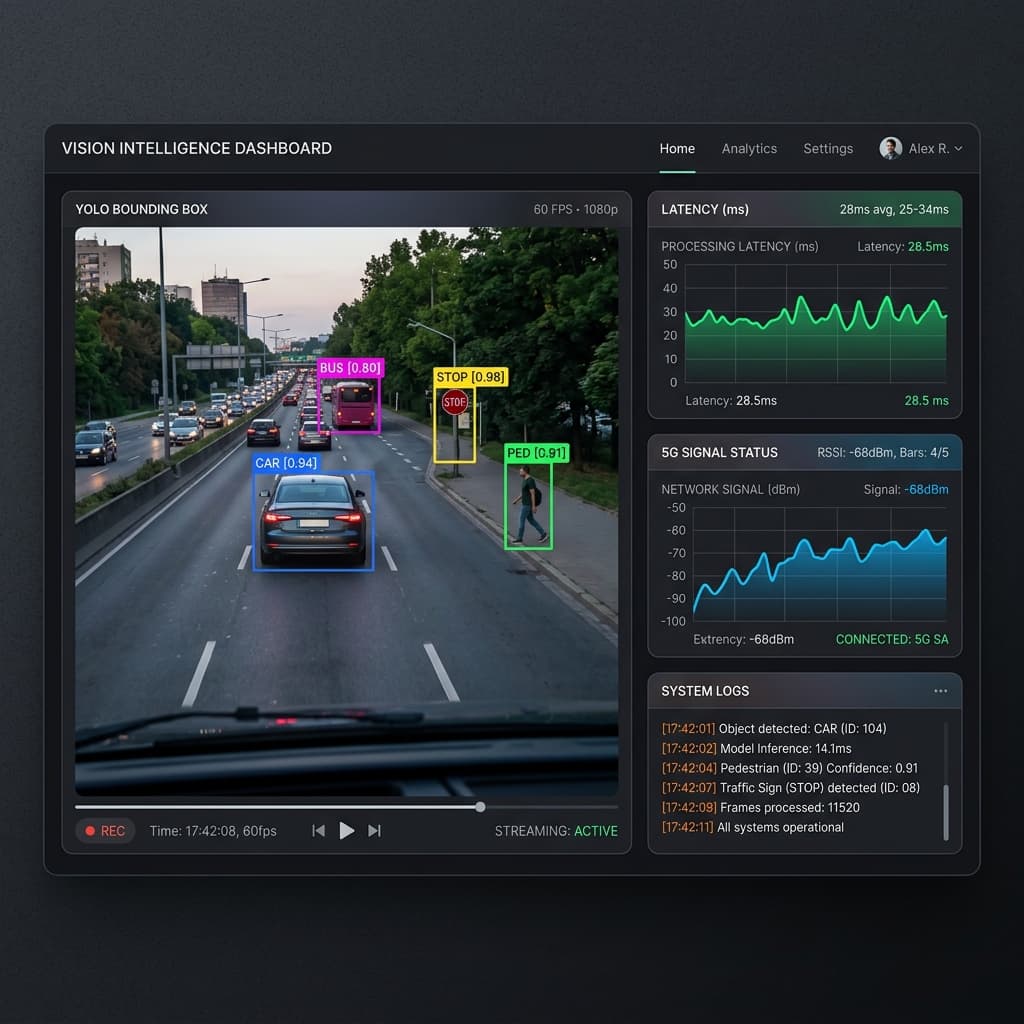
Road accidents are a data problem before they are a hardware problem. We asked what a camera could prevent if it never blinked — and never lagged.
- Role
- Team Captain, Project Coordinator & AI/ML Engineer
- Team
- 5Genç
- Stage
- Completed (TEKNOFEST 2026)
- Measured F1
- 0.716, up from 0.250
01Challenge
Assisted and autonomous driving systems need to see hazards — vehicles, pedestrians, unexpected obstacles — in real time, and a detection that arrives late is a detection that never happened. The system had to combine low-latency 5G transport with vision models fast enough to matter at road speed.
02Approach
The perception layer was my own hands-on work: YOLO-family models, trained and iterated in Python on scenario-specific datasets until they held up at road speed. Rather than one model carrying every label, detection was split into separately trained experts — adding or removing one is a line in a config file, not a change to the code. The 5G transport carrying those detections was the team's infrastructure side, and as captain I coordinated where the two halves met: what the models emit, what the network expects, and where the deadline actually sat.
03Outcome
The competition run closed in August 2026. Measured against the official ground truth on Turkcell's validation footage, the delivered system scored an F1 of 0.716 — up from 0.250 over three iterations. Most of that climb came from calibration rather than retraining, which is not where I expected to find it. The plate model reached mAP@50 0.992 at 113 FPS on a Tesla T4, with the machine offline and inside a ten-minute budget.
Curious about the technical details?
Ask the AI assistant directly about architecture choices, model training, and pipelines.
Next project