02 / 03
EdTech · Web Platform2026
- AI-assisted
- Photo Sphere Viewer
- Leaflet
- Express
- PostgreSQL
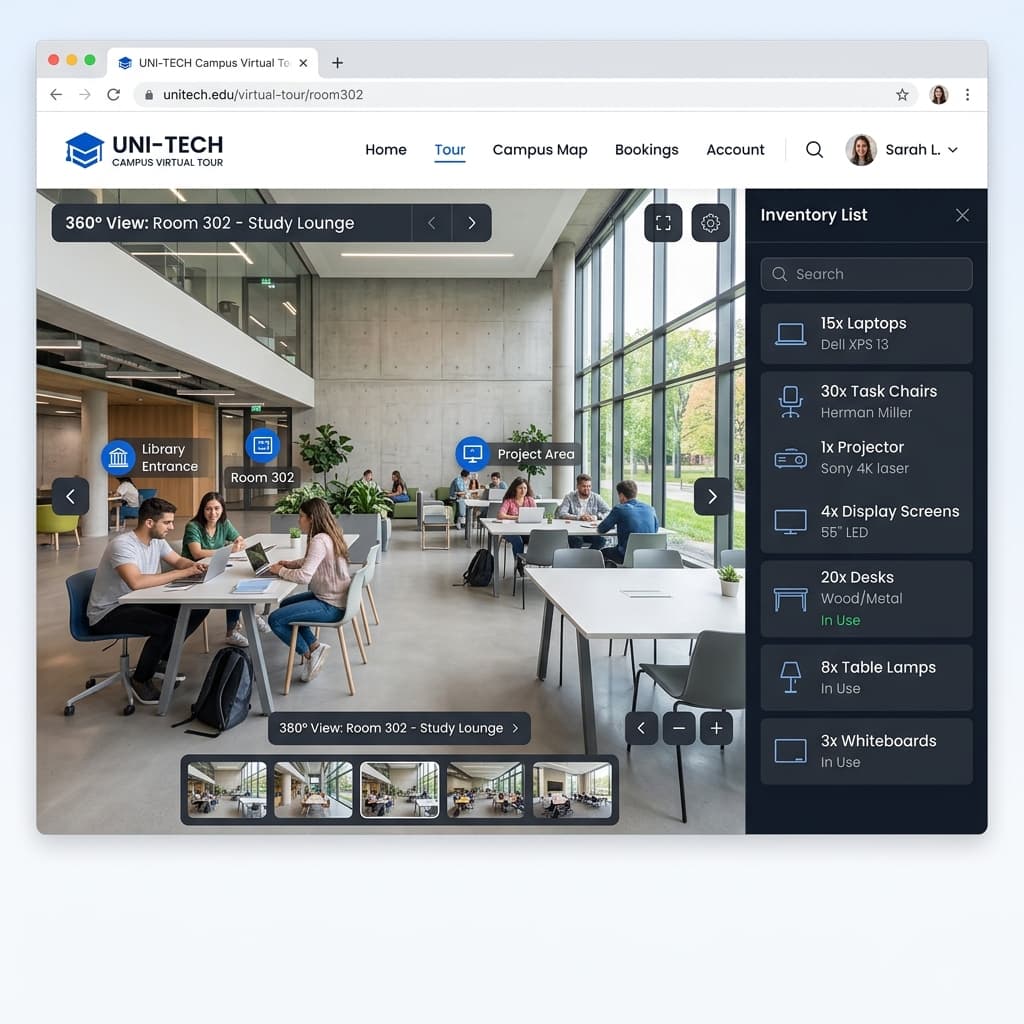
A campus is a place you should be able to visit before you arrive — and an asset list someone has to keep honest. Virtual Campus does both from the same platform.
- Role
- Software Engineering Student
- How it was built
- AI-assisted development
- Frontend
- React + Vite, Tailwind CSS
- 360° & maps
- Photo Sphere Viewer + Leaflet
- Backend
- Express + Prisma on Node.js
- Database
- PostgreSQL 16 (Docker)
- Status
- In development
01Challenge
Prospective students want to see the campus without traveling to it, and administration needs to track inventory across the same buildings — two problems usually solved by two disconnected tools. The goal was one platform: smooth 360° navigation on any device, backed by structured, queryable data.
02Approach
I built this the way I build most web work now: deciding the architecture and the data model myself, then writing it alongside language models rather than hand-rolling every layer. My part is the shape of the thing — what talks to what, which room maps to which record — and the review that keeps it coherent. Photo Sphere Viewer renders the panoramic scenes inside a React shell built with Vite, Leaflet carries the campus map, and an Express API backed by Prisma serves scene and inventory data from PostgreSQL, so the room a visitor tours is the room whose equipment records live in the database.
03Outcome
Still in development. The core architecture is standing — panoramic scenes, the campus map and the Prisma-backed inventory API all talk to each other — and the work now is capturing new campus locations and building out the admin dashboard. It is also where I learned how far this way of working carries a project, and where the judgement still has to be mine.
Curious about the technical details?
Ask the AI assistant directly about architecture choices, model training, and pipelines.
Next project